Team Profile
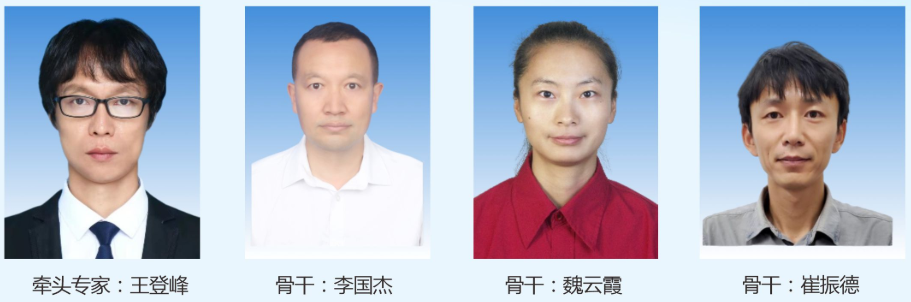
Lead Expert: Wang Dengfeng
Core Members: Li Guojie, Wei Yunxia, Cui Zhende
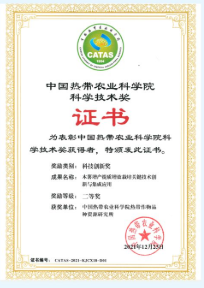
The team currently consists of 16 members, including 2 professors, 4 associate professors, and 4 Ph.D. holders. Over the past five years, significant breakthroughs have been achieved in cassava agricultural machinery-agronomy integration, intercropping, fertilization, and stress-tolerant cultivation. The team has undertaken more than 10 provincial/ministerial and above research projects, including the National Key R&D Program, the National Cassava Industrial Technology System Cultivation and Physiology Post, Guangxi Major Science and Technology Projects, Hainan Provincial International Science and Technology Cooperation R&D Projects, and Hainan Provincial Natural Science Foundation. Forty academic papers have been published, including 6 SCI papers. The team has been granted 13 patents, including "A seed stem preparation and cutting device for cassava planting." Two technologies—"cassava wide-narrow double-row ridging planting and supporting full-mechanized technology" and others—have been selected as recommended technologies by the Ministry of Agriculture and Rural Affairs and Hainan Province. Three standards have been completed, including the agricultural industry standard Technical Specification for Full-Mechanized Cassava Production and Hainan provincial local standards. The team has received the Second Prize of the CATAS Science and Technology Award. To date, more than 400 sets of full-mechanized cassava production technologies and equipment have been promoted in major cassava-producing areas of Guangxi, Guangdong, and Hainan, as well as in more than ten Belt and Road countries including Cambodia, Laos, Ghana, and Papua New Guinea in Southeast Asia, West Africa, and the South Pacific. Over 20 domestic and overseas technical demonstration bases have been established, and more than 400 officials and technical personnel from Southeast Asia, Africa, and other regions have been trained.
Research Directions
(1) Research on Cassava Agricultural Machinery-Agronomy Integrated Production Technologies. The team conducts research, application, and extension of high-yield and high-efficiency cultivation technologies integrating agricultural machinery and agronomy. It addresses the prominent contradictions between high-yield, high-quality cultivation agronomy and precise, efficient mechanized equipment throughout the entire cassava production process. Based on the aboveground growth characteristics and underground root (tuber) morphology of different cassava varieties, combined with corresponding agronomic requirements and regional terrain and soil conditions, the team develops advanced, rational, applicable, and mechanization-compatible integrated production technology models.
(2) Research on Precision Cassava Planting Technologies and Equipment. First, key technologies for precision cassava planting: following mechanization-friendly principles and targeting reduced seed use, low fertilizer consumption, energy savings, and simplified operations, the team proposes agronomic standards based on precise dimensions, measurable quantification, and rapid mechanical repeatability. Second, high-precision cassava combined planters: the team investigates the dynamic characteristics and posture changes during cassava seed stem planting, and develops high-precision planters with intelligent detection systems, including real-time cutting-type combined planters suitable for straight-stem varieties and pre-cutting-type combined planters suitable for low-branching varieties.
(3) Research and Development of Efficient Cassava Harvesting Technologies and Equipment. First, pre-harvest straw efficient treatment: the team analyzes cassava straw crushing mechanisms, optimizes blade structures and arrangements, and develops high-efficiency straw shredding and returning equipment with ridge-following crushing mechanisms and intelligent blade-to-ground clearance control, addressing high energy consumption and root damage caused by unstable clearance. Second, combined high-efficiency and low-loss harvesting equipment: targeting high tuber recovery, low damage, low energy consumption, and automatic picking, the team develops cassava combined harvesters featuring intelligent digging depth control, reciprocating micro-cutting drag-reduction digging, staggered low-angle screening soil separation, and static root-plant conveying.
Achievements and Awards
(1) Development of key technologies for cassava yield, quality, and efficiency improvement.
Based on the concept of root (tuber) morphology defining three-dimensional spatial distribution characteristics of cassava underground parts, a root-type research and evaluation system was established. A mechanization-friendly wide-narrow row configuration cultivation model for cassava monoculture and intercropping systems was proposed and optimized, providing optimized agronomic parameters for full-mechanized ridging, planting, fertilization, and harvesting. A reduced-input, quality-enhancing, and efficiency-improving fertilization technology was developed, proposing the "large formula, small adjustment" strategy: "reduce phosphorus, control nitrogen and potassium in total; increase nitrogen and potassium in base fertilizer; reduce nitrogen and increase potassium in topdressing; and apply appropriate medium and micronutrients."
(2) Development of cassava wide-narrow double-row ridging planting and supporting full-mechanized technology.
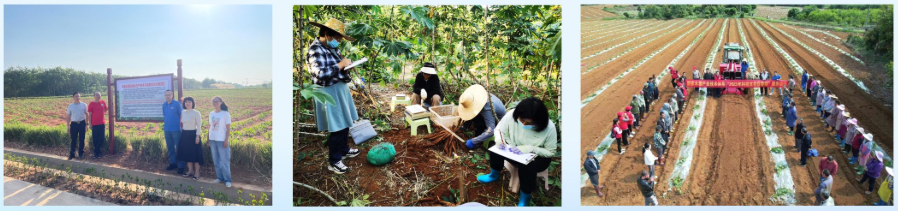
This technology was selected as a recommended technology by the Ministry of Agriculture and Rural Affairs in 2021 and as one of the Top Ten Major Technologies for Tropical Crops in 2023. Optimized parameters for cassava wide-narrow double-row ridging planting were established, with supporting self-developed equipment including rotary tillage ridgers, ridging-type double-row cassava planters, sprayers, straw shredding and returning machines, and root diggers, achieving the goal of no tire damage to ridges, crops, or cassava roots during full-mechanized operations, effectively realizing agricultural machinery-agronomy integration.
(3) Extension and application of full-mechanized cassava production technologies and equipment serving the Belt and Road Initiative.
In recent years, more than 400 sets of full-mechanized cassava production technologies and equipment have been promoted in major cassava-producing areas of Guangxi, Guangdong, and Hainan, as well as in more than ten Belt and Road countries including Cambodia, Laos, Ghana, and Papua New Guinea. Over 20 domestic and overseas technical demonstration bases have been established. The team has received visits from David Kaatrud, Director of the Humanitarian and Development Division of the World Food Programme (WFP), the Secretary-General of the Indonesian Rural Cooperative Union and enterprise leaders, and more than 200 visitors. Over 400 officials and technical personnel from Southeast Asia, Africa, and other regions have been trained.
Team Highlights
Contact Information
Name: Wei Yunxia
Tel: 15298908924
Email: mydearxiaowei@126.com